Older High Point Houses and Where Mold Starts
High Point's housing runs older than North Carolina's as a whole. Knowing roughly when your house was built tells you where to look first.
High Point's median home was built in 1989, but 40% of its homes predate 1980 and 7.6% predate 1940 (U.S. Census, ACS 2020–2024). In older houses, mold most often starts at original plumbing, worn crawl space liners and bathrooms that were never vented to the outdoors.
How old are High Point's homes?
The city has 49,131 housing units. Their median year built is 1989; 40.0% went up before 1980, 7.6% before 1940, and 10.4% in 2010 or later. About 58% are owner-occupied and 42% rented (U.S. Census, ACS 2020–2024). Statewide, the median North Carolina home dates to 1991 and 33.9% predate 1980, so High Point carries a larger share of older houses than the state overall (U.S. Census).
Where are the oldest houses?
High Point was incorporated in 1859 and named for the highest point on the North Carolina Railroad line of 1856. Its historic districts include Uptown Suburbs, which takes in Emerywood, along with Oakwood, Washington Street and West High Street. Highland Cotton Mills Village is listed on the National Register of Historic Places. Houses in these areas are the ones most likely to have original plaster, old drain lines and crawl spaces that have been patched many times.
Where does each era tend to leak?
- Before 1940: plaster walls that hide slow leaks, crawl spaces with bare dirt, and few or no bath fans.
- 1940s to 1970s: galvanized supply pipes that corrode from inside, thin or missing vapor barriers, single-pane windows that sweat in winter.
- 1980s to 2000s: aging water heaters, washing machine hoses, and ductwork in hot attics.
- 2010 and later: tighter walls that hold moisture in, so a bath fan venting into the attic matters more.
What should you check this weekend?
Open the crawl space door and look for standing water, a torn or missing liner and drooping insulation. Run each bath fan and confirm the air leaves the house. Check under sinks and behind the washer for stains. If anything turns up, read about crawl space mold in High Point or book a mold inspection. For budgeting, see what mold repair costs in High Point.
What does one old mill village show?
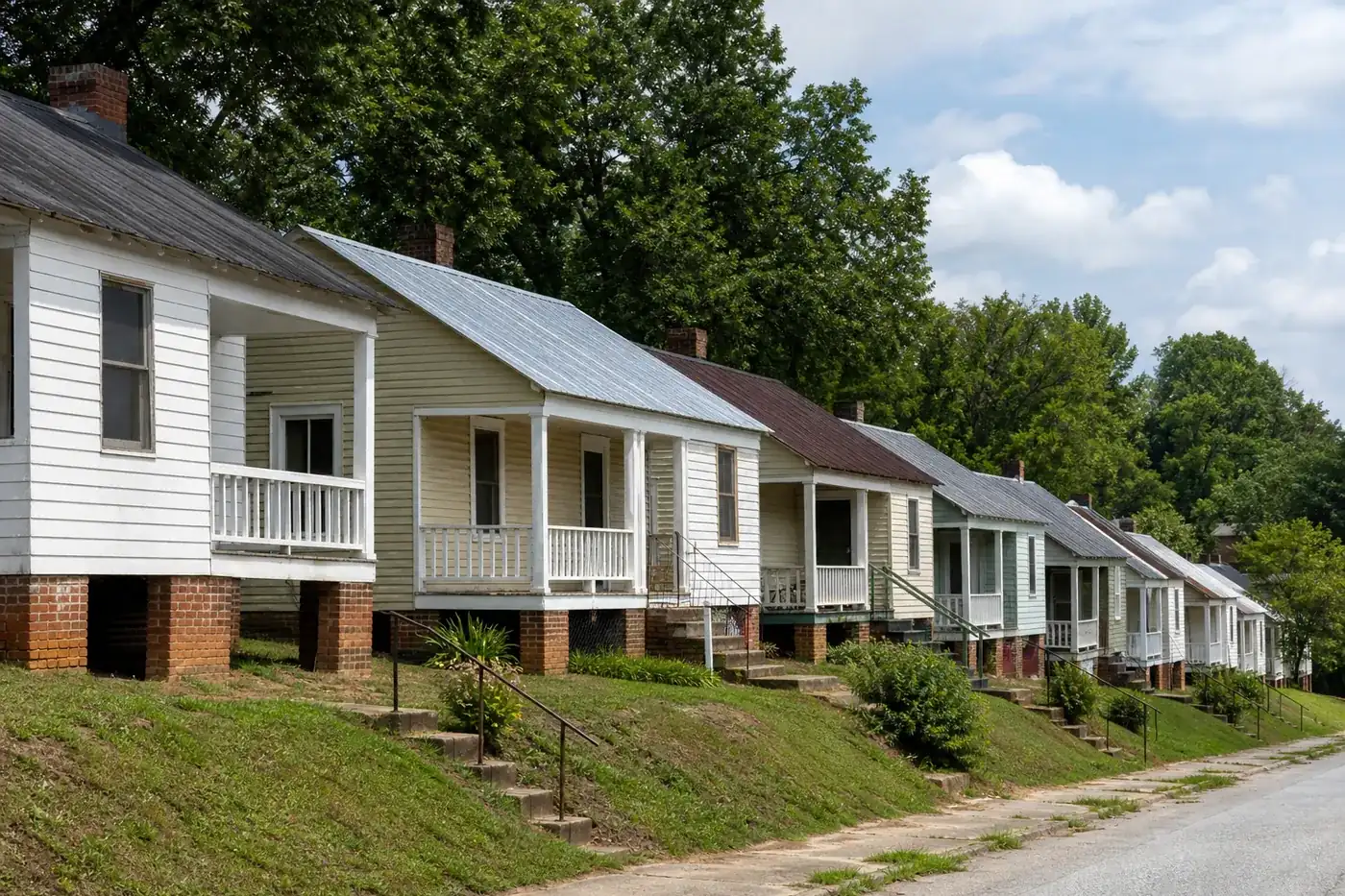
The National Register nomination for the Highland Cotton Mills Village Historic District, in southwest High Point, describes nine streets of one-story frame mill houses around a mill that opened in 1913. Every house sits on brick: open piers under the earlier houses and solid brick under the later ones. The streets slope toward Richland Creek and one of its tributaries, so on some blocks the front of a house stands high off the ground while the back sits close to it (North Carolina State Historic Preservation Office).
That mix is common in High Point's oldest neighborhoods. On a sloped lot, the low side of the crawl space is where soil stays damp and air moves least, and it is usually the first corner worth checking with a flashlight.
Sources
- U.S. Census Bureau, American Community Survey 2020-2024, table B25034: year structure built, High Point city, North Carolina
- U.S. Census Bureau, American Community Survey 2020-2024, table B25034: year structure built, North Carolina
- North Carolina State Historic Preservation Office: National Register nomination, Highland Cotton Mills Village Historic District
Ask for a High Point mold inspection
Say what you've noticed and where. An independent mold specialist who works in High Point calls you back to pick a time.